

Training Data
What is Reverse ETL and Why Do We Need It?
At Vatico, maintaining a scalable data ecosystem is key to our operational success. As part of migrating our CRM into Docker, we simplified our systems into a Reverse ETL workflow. In this post, we explain Reverse ETL, why we adopted it to decouple WooCommerce order status sync from our CRM, and how this architecture improves stability and maintenance for both human engineers and automated agents.
What is Reverse ETL?
In a standard ETL (Extract, Transform, Load) pipeline, raw transactional data is extracted from production sources (like WooCommerce) and loaded into a centralized data warehouse for analytics and reporting.
However, business operations teams work in applications and tools like our CRM. Reverse ETL bridges this gap: it takes modeled data from our data pipelines and syncs it directly back into our applications or tools. Allowing for non-engineers to access timely data in their respective application.
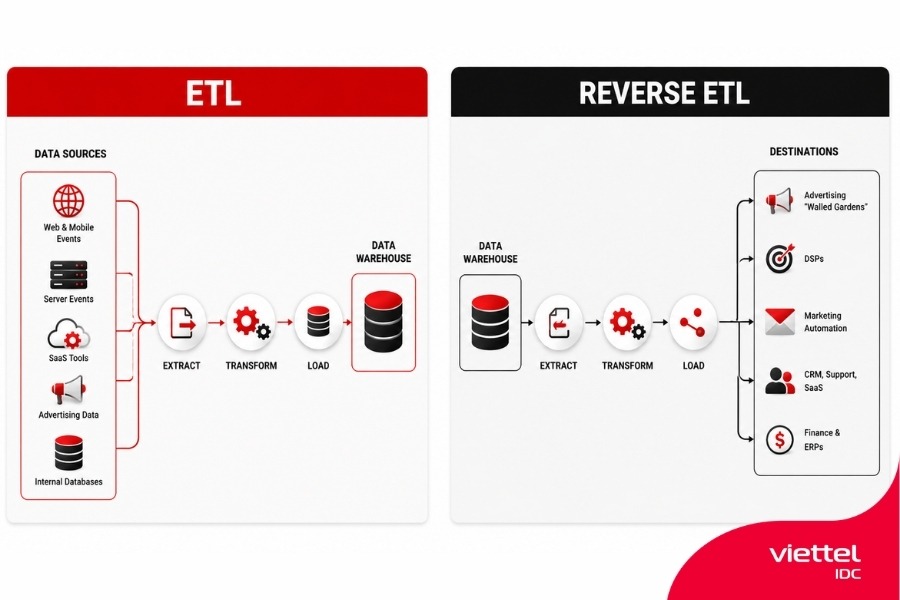
Visualizing standard ETL (ingestion) vs. Reverse ETL (operational sync)
Source: Viettel IDC, .n.d.
Vatico Reverse ETL CRM Architecture
WooCommerce
source system capturing sale orders
→
Data Pipeline (ELT)
Ingests and processes raw data from source systems.
→
Reverse ETL VM
Dedicated service VM running sync logic.
→
CRM System
Target application used by business teams.
The Business Case at Vatico: Decoupling the Sync
Historically, WooCommerce order status was synced to our CRM via a custom Python/Django script running inside the CRM application VM. This tightly coupled design utilized too many moving parts and made the environment complex for Vatico Bot to maintain.
With our migration of the CRM into a Docker container, keeping the ELT and Reverse ETL processes together in the CRM VM made these processes tightly coupled and not easily replaceable. Separating these processes into a dedicated VM decoupled them from the CRM, making the architecture modular and components more replaceable. Because if we need to upgrade or swap out our sync logic or CRM in the future, we can do so easily by replacing the logical component (e.g. Virtual Machine) without breaking our existing ELT and Reverse ETL synchronization scripts.
❌ The Old Way (Tightly Coupled)
WooCommerce status data was fetched and synced using custom Python/Django jobs running directly within the CRM’s application VM.
The Drawbacks: Difficult for agents to maintain, and a
tightly coupled architecture that hindered Docker containerization.
✓ The New Way (Decoupled Reverse ETL)
The ELT and Reverse ETL processes are moved onto a dedicated VM, decoupling them from the CRM. Whilst ensuring data are sent to applications in a timely manner.
The Benefits: Separating the sync logic makes the CRM sync logic more replaceable
and in addition to that having all data syncs in one separated module makes it easier for Vatico Bot
to maintain and diagnose issues as the bot is well versed on industry deployment standards.
Why We Did It: Technical Benefits
1. Simplified CRM Architecture: Separating the ELT and Reverse ETL into their own dedicated VM decoupled them from the CRM. This allowed the CRM application to focus solely on customer relationship management, making Docker containerization straightforward and the components highly replaceable.
2. Data & Sales Transparency: Using Reverse ETL ensures WooCommerce order information updates directly inside the CRM. Why it matters: The core benefit is that sales staff can track payments, orders, and shipment details instantly within their existing tool, eliminating the need to wait on the data team to access the source of truth for the data they are viewing.
3. Empowers Vatico Bot: Centralizing sync logs and processes in a dedicated VM makes it far easier for Vatico Bot to monitor, diagnose issues, and safely maintain the system. Furthermore, adopting industry-standard deployment structures aligns directly with the architectural patterns the bot is pre-trained to understand, preventing layout confusion and facilitating seamless automated maintenance.
References
-
1
Viettel IDC: Reverse ETL là gì? Cách đưa dữ liệu từ kho vào hệ thống vận hành https://www.viettelidc.com.vn/tin-tuc/reverse-etl-la-gi-cach-dua-du-lieu-tu-kho-vao-he-thong-van-hanh-5561
-
2
Talend: What is Reverse ETL? Overview and Best Practices https://www.talend.com/resources/reverse-etl/
-
3
Hightouch: What is Reverse ETL? The Definitive Guide https://hightouch.com/blog/reverse-etl